A. Reciting and memorizing prayers
By the next class, the students should finish memorizing the prayer that they have been learning over the past few lessons. You will want to make sure, then, that they are advancing well in their efforts. You will first, of course, begin the class with prayers.
By the next class, the students should finish memorizing the prayer that they have been learning over the past few lessons. You will want to make sure, then, that they are advancing well in their efforts. You will first, of course, begin the class with prayers.
B. Songs (including a review of previous songs)
I Want to Be Happy - listen HERE
There is something you must know
In this Faith we have to show
We are men of deeds, not of words
Our very life should show our Faith to friend and foe
CHORUS:
I want to be happy
I want to be strong
To be His servant
My whole life long
So, I must obey the laws of God
Yes, I must obey the laws of God
There is something you must know
In this world of pomp and show
People are tired of empty speech
They want to see you practice what you teach
CHORUS
I Want to Be Happy - listen HERE
There is something you must know
In this Faith we have to show
We are men of deeds, not of words
Our very life should show our Faith to friend and foe
CHORUS:
I want to be happy
I want to be strong
To be His servant
My whole life long
So, I must obey the laws of God
Yes, I must obey the laws of God
There is something you must know
In this world of pomp and show
People are tired of empty speech
They want to see you practice what you teach
CHORUS
C. Memorizing quotations
The children will learn the following quotation by heart today. Below are some ideas to help you explain the quotation to your students:
A faithful soul never forgets its love for God. It is out of our faithfulness to Him that we always put forth effort to follow His teachings and obey His laws, even when it becomes difficult. So it is that we work hard to serve others and to do worthy deeds, with no other thought than attaining His good pleasure. For the faithful soul there is no greater joy than striving to please God. Let us memorize this quotation of Bahá’u’lláh:
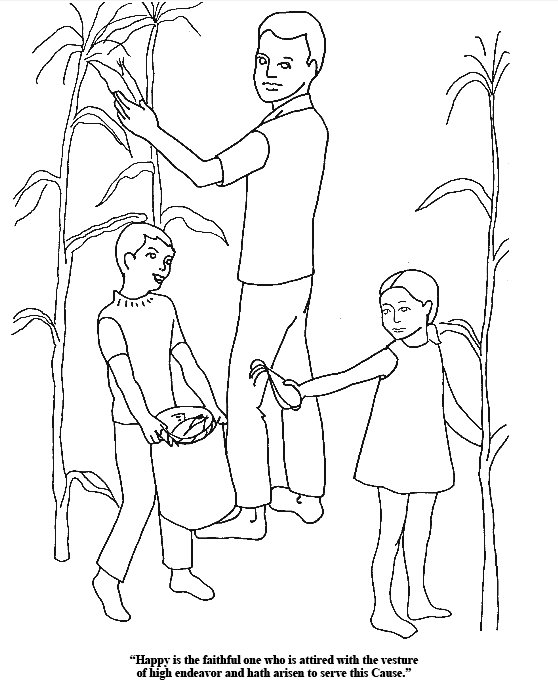
“Happy is the faithful one who is attired with the vesture of high endeavour and hath arisen to serve this Cause.” listen HERE
Attired
1. Mae has a good dress that she only wears on special occasions. She put on her dress for the community gathering. Mae was attired in her special dress.
2. For the ceremony, the King put on his velvet robe. He was attired in his finest clothes.
Vesture
1. In some places, judges must wear a white wig and a long black robe in a court of law. They must wear the full vesture of judges.
2. Before leaving the palace, the prince puts on his sash and crown. He puts on his royal vesture.
Endeavor
1. The students decided to plant trees around the school. The community supported their endeavor by providing seedlings and soil.
2. Pierre and Arlene decided that they would climb to the top of the mountain. They knew that this would be a difficult endeavor, but they were determined to try.
[Quotes from other religions:
Christianity: If you have faith as small as a mustard seed, you can say to this mountain, 'Move from here to there' and it will move. Nothing will be impossible for you. Matthew 17:20
Islam: Such is God, your Sustainer: there is no deity save Him, the Creator of everything: worship, then, Him alone -for it is He who has everything in His care. Quran 6:102 (Asad)]
The children will learn the following quotation by heart today. Below are some ideas to help you explain the quotation to your students:
A faithful soul never forgets its love for God. It is out of our faithfulness to Him that we always put forth effort to follow His teachings and obey His laws, even when it becomes difficult. So it is that we work hard to serve others and to do worthy deeds, with no other thought than attaining His good pleasure. For the faithful soul there is no greater joy than striving to please God. Let us memorize this quotation of Bahá’u’lláh:
“Happy is the faithful one who is attired with the vesture of high endeavour and hath arisen to serve this Cause.” listen HERE
Attired
1. Mae has a good dress that she only wears on special occasions. She put on her dress for the community gathering. Mae was attired in her special dress.
2. For the ceremony, the King put on his velvet robe. He was attired in his finest clothes.
Vesture
1. In some places, judges must wear a white wig and a long black robe in a court of law. They must wear the full vesture of judges.
2. Before leaving the palace, the prince puts on his sash and crown. He puts on his royal vesture.
Endeavor
1. The students decided to plant trees around the school. The community supported their endeavor by providing seedlings and soil.
2. Pierre and Arlene decided that they would climb to the top of the mountain. They knew that this would be a difficult endeavor, but they were determined to try.
[Quotes from other religions:
Christianity: If you have faith as small as a mustard seed, you can say to this mountain, 'Move from here to there' and it will move. Nothing will be impossible for you. Matthew 17:20
Islam: Such is God, your Sustainer: there is no deity save Him, the Creator of everything: worship, then, Him alone -for it is He who has everything in His care. Quran 6:102 (Asad)]
D. Story
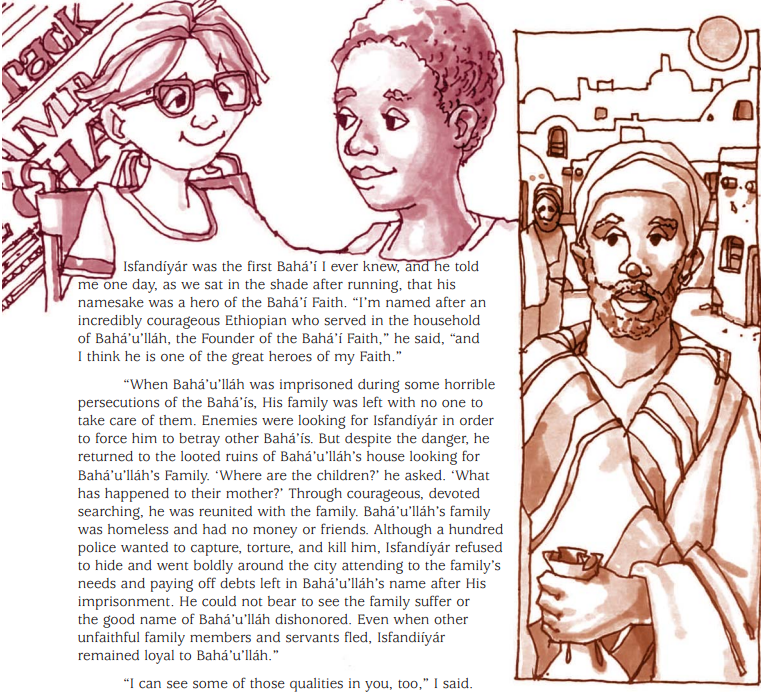
When ‘Abdu’l-Bahá was a young boy, His family, which was part of the nobility of Persia, had a servant by the name of Iṣfandíyár. He was very loyal to the family, and they trusted him a great deal. When the authorities, out of prejudice and ignorance, had ‘Abdu’l-Bahá’s beloved Father, Bahá’u’lláh, arrested, all of the family’s possessions were taken away. They were left with nothing, and anyone close to Bahá’u’lláh was in danger. Still, Iṣfandíyár continued to look after the family. Knowing that many officers would be looking for Iṣfandíyár, ‘Abdu’l-Bahá’s mother urged him to leave the city. But Iṣfandíyár would not leave.
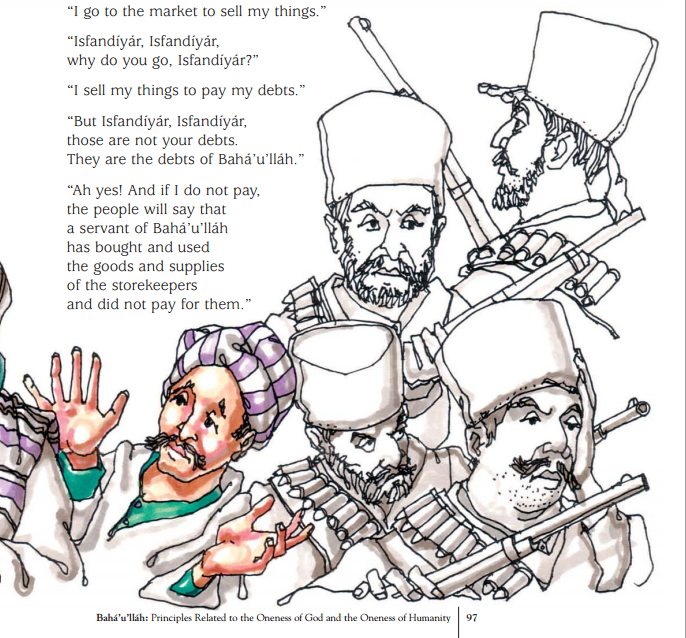
“I cannot go,” he said, explaining that he owed money to many shopkeepers for items he had purchased. “How can I go?” he asked. “They will say that the servant of Bahá’u’lláh has bought and consumed the goods and supplies of the storekeepers without paying for them. Unless I pay all these obligations, I cannot go. But if they take me, never mind. If they punish me, there is no harm in that. If they kill me, do not be grieved. But to go away is impossible. I must remain until I pay all I owe.”
For one month Iṣfandíyár went about in the streets and bazaars, selling small things he owed. When he had paid every last debt, he went to the family and said good-bye, for he knew he could stay with them no longer. A minister agreed to take him in and protect and shelter him during this dangerous time.
Many months later, Bahá’u’lláh was released from prison and He and His family were exiled from Persia by the authorities. They went to Baghdád, a city in the neighboring country. Iṣfandíyár, ever faithful to Bahá’u’lláh, journeyed to Baghdád to ask whether he could once again serve in His household. Bahá’u’lláh said to him, “When you left us, there was a Persian minister who gave you a place to stay when no one else could give you protection. Because he gave you shelter and protected you, you must be faithful to him. If he is satisfied to have you go, then come to us; but if he does not want you to go, do not leave him.”
Of course, Iṣfandíyár was so upright, so trustworthy and loyal, that the minister did not want him to go. “O Iṣfandíyár!” he exclaimed, “I am not willing that you should go, yet, if you wish to go, let it be according to your own will.” But Iṣfandíyár remembered Bahá’u’lláh’s words. He remained in the minister’s service until, some time later, the minister passed away and Iṣfandíyár once again returned to the family he so loved, serving ‘Abdu’l-Bahá to the end of his days.
When ‘Abdu’l-Bahá was a young boy, His family, which was part of the nobility of Persia, had a servant by the name of Iṣfandíyár. He was very loyal to the family, and they trusted him a great deal. When the authorities, out of prejudice and ignorance, had ‘Abdu’l-Bahá’s beloved Father, Bahá’u’lláh, arrested, all of the family’s possessions were taken away. They were left with nothing, and anyone close to Bahá’u’lláh was in danger. Still, Iṣfandíyár continued to look after the family. Knowing that many officers would be looking for Iṣfandíyár, ‘Abdu’l-Bahá’s mother urged him to leave the city. But Iṣfandíyár would not leave.
“I cannot go,” he said, explaining that he owed money to many shopkeepers for items he had purchased. “How can I go?” he asked. “They will say that the servant of Bahá’u’lláh has bought and consumed the goods and supplies of the storekeepers without paying for them. Unless I pay all these obligations, I cannot go. But if they take me, never mind. If they punish me, there is no harm in that. If they kill me, do not be grieved. But to go away is impossible. I must remain until I pay all I owe.”
For one month Iṣfandíyár went about in the streets and bazaars, selling small things he owed. When he had paid every last debt, he went to the family and said good-bye, for he knew he could stay with them no longer. A minister agreed to take him in and protect and shelter him during this dangerous time.
Many months later, Bahá’u’lláh was released from prison and He and His family were exiled from Persia by the authorities. They went to Baghdád, a city in the neighboring country. Iṣfandíyár, ever faithful to Bahá’u’lláh, journeyed to Baghdád to ask whether he could once again serve in His household. Bahá’u’lláh said to him, “When you left us, there was a Persian minister who gave you a place to stay when no one else could give you protection. Because he gave you shelter and protected you, you must be faithful to him. If he is satisfied to have you go, then come to us; but if he does not want you to go, do not leave him.”
Of course, Iṣfandíyár was so upright, so trustworthy and loyal, that the minister did not want him to go. “O Iṣfandíyár!” he exclaimed, “I am not willing that you should go, yet, if you wish to go, let it be according to your own will.” But Iṣfandíyár remembered Bahá’u’lláh’s words. He remained in the minister’s service until, some time later, the minister passed away and Iṣfandíyár once again returned to the family he so loved, serving ‘Abdu’l-Bahá to the end of his days.

 |  |
 |  |
 |  |
 |  |
 |  |
E. Game: “Who is knocking at my door?”
Blindfold one of the children, who should be seated on a bench with his or her back to the rest of the class. Now point to another child. He or she should go up to the blindfolded child and knock on the bench. The child who is seated says, “Who is knocking at my door?” The other, trying to disguise his or her voice, responds, “It’s me!” The seated child tries to guess who is knocking. The blindfolded child has three guesses, and then another child is given a turn.
Blindfold one of the children, who should be seated on a bench with his or her back to the rest of the class. Now point to another child. He or she should go up to the blindfolded child and knock on the bench. The child who is seated says, “Who is knocking at my door?” The other, trying to disguise his or her voice, responds, “It’s me!” The seated child tries to guess who is knocking. The blindfolded child has three guesses, and then another child is given a turn.
F. Colouring: Drawing 22
G. Closing prayers

| lesson22faithfultogod.pdf |
Faithfulness - from The Family Virtues Guide
"Be faithful til death, and I will give you the crown of life." - John 2:10
What is Faithfulness?
Faithfulness is being true to someone or something. It is holding to what you believe is important no matter what happens. Faithfulness is belief that stands up to the test of time. It is starting out on a path and staying on it no matter how many times you stop or get distracted.
Faithfulness is being like a rock in the midst of rushing waters. You stand firm no matter what. It comes from really knowing and living what you believe. When you are faithful you can be counted on and trusted. You show up when you said you would show up. You keep your commitments regardless of what you would rather do.
Faithfulness is needed when you have beliefs and principles that can't be proven to others. If you are faithful to your beliefs, such as belief in God, honesty or friendship, others can see your values in the way you act.
Why Practice Faithfulness?
When people don't show faithfulness, they say one thing and do another. One day they believe something, and the next day they believe something else. You never know that they believe. They probably don't know what they believe wither. You can never count on them for anything. They say they will be somewhere, but then if something distracts them, they don't show up. They change their minds a lot. You never know where they stand. So people stop trusting them.
When people are faithful, you know what they stand for, and you can trust them. You see their beliefs in their lives. You can count on them to keep their agreements. When people are faithful, they get things gone regardless of distractions that come up. They are faithful friends.
Once a friend, always a friend.
How Do You Practice It?
Being faithful means you keep promises. You only make agreements you keep. You walk your talk. If you say you will do something for someone else, you do it even if you feel like doing something else instead.
To do a job faithfully means you do it with as much excellence and precision as you can. And you do it on time.
You practice faithfulness by learning and questioning and finding answers about your beliefs. As you grow in your beliefs, you practice them as faithfully as you can.
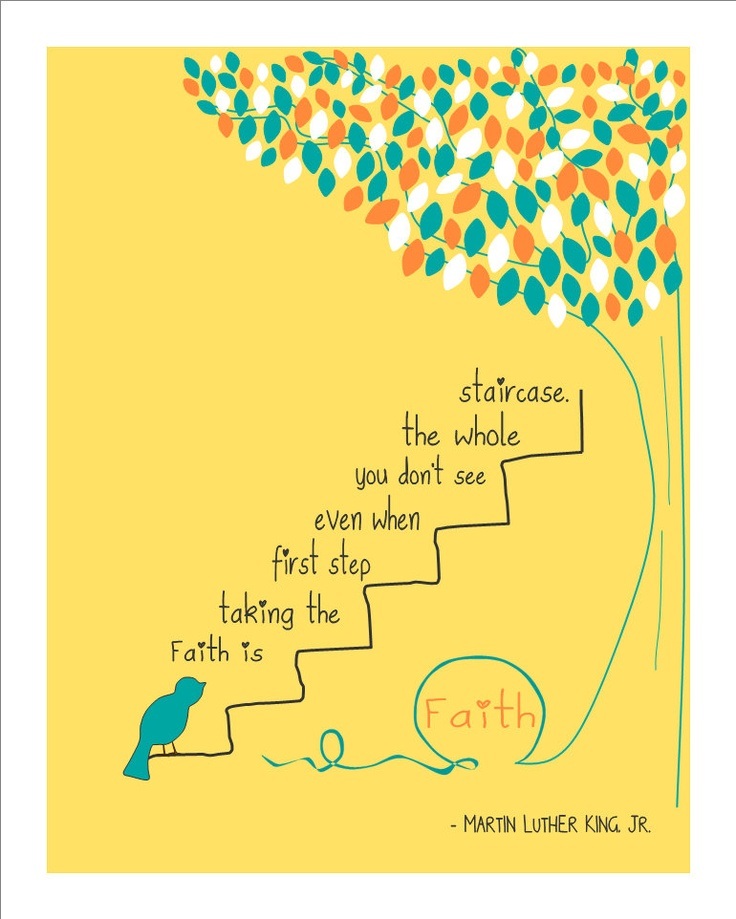
Listen to your heart when things come up to test your faith. Faith is not really faith unless it is tested. Your faith gets stronger when your beliefs are tested and you still find that they are true.
When you are faithful in relationships, you are loyal. You don't talk about someone behind their back. If you feel mad or hurt, you go to them and talk about it privately. You don't leave an old friend when a new one comes along.
You make the circle wider.
What would faithfulness look like if...
What is Faithfulness?
Faithfulness is being true to someone or something. It is holding to what you believe is important no matter what happens. Faithfulness is belief that stands up to the test of time. It is starting out on a path and staying on it no matter how many times you stop or get distracted.
Faithfulness is being like a rock in the midst of rushing waters. You stand firm no matter what. It comes from really knowing and living what you believe. When you are faithful you can be counted on and trusted. You show up when you said you would show up. You keep your commitments regardless of what you would rather do.
Faithfulness is needed when you have beliefs and principles that can't be proven to others. If you are faithful to your beliefs, such as belief in God, honesty or friendship, others can see your values in the way you act.
Why Practice Faithfulness?
When people don't show faithfulness, they say one thing and do another. One day they believe something, and the next day they believe something else. You never know that they believe. They probably don't know what they believe wither. You can never count on them for anything. They say they will be somewhere, but then if something distracts them, they don't show up. They change their minds a lot. You never know where they stand. So people stop trusting them.
When people are faithful, you know what they stand for, and you can trust them. You see their beliefs in their lives. You can count on them to keep their agreements. When people are faithful, they get things gone regardless of distractions that come up. They are faithful friends.
Once a friend, always a friend.
How Do You Practice It?
Being faithful means you keep promises. You only make agreements you keep. You walk your talk. If you say you will do something for someone else, you do it even if you feel like doing something else instead.
To do a job faithfully means you do it with as much excellence and precision as you can. And you do it on time.
You practice faithfulness by learning and questioning and finding answers about your beliefs. As you grow in your beliefs, you practice them as faithfully as you can.
Listen to your heart when things come up to test your faith. Faith is not really faith unless it is tested. Your faith gets stronger when your beliefs are tested and you still find that they are true.
When you are faithful in relationships, you are loyal. You don't talk about someone behind their back. If you feel mad or hurt, you go to them and talk about it privately. You don't leave an old friend when a new one comes along.
You make the circle wider.
What would faithfulness look like if...
- You told your father you would come right home but you are tempted to go with your friends to do something fun?
- You feel some doubt inn your beliefs because people you admire don't agree with them?
- A new friend tries to get you to give up an old one?
- You have some homework to do and don't feel like doing the whole thing?
- You agreed to do a chore for your family every Saturday?
| Congratulations! You are practising faithfulness when you...
| Keep trying! You need more practice when you...
|
AFFIRMATION
I am faithful to what I believe. I am a faithful friend. I do not backbite. I clear up my problems face to face. I keep my problems. I walk my talk.
I am faithful to what I believe. I am a faithful friend. I do not backbite. I clear up my problems face to face. I keep my problems. I walk my talk.
   |    |    |
 RSS Feed
