A. Reciting and memorizing prayers
Begin the class with prayers and then help the children to learn a few more phrases from the prayer introduced in the last lesson.
Begin the class with prayers and then help the children to learn a few more phrases from the prayer introduced in the last lesson.
B. Song (including a review of previous songs)
Busy Hands listen HERE
CHORUS:
Busy hands make happy children
Happy children can be found
Making other people happy
Spreading peace and love around
Working hands to build a new world
Everybody has a role
All of us can be so thankful
For we soon shall reach our goal
CHORUS
God will help us build a new world
Where we all help someone else
All of us will love our neighbor
More than we love our own selves
CHORUS (with last line repeated)
Busy Hands listen HERE
CHORUS:
Busy hands make happy children
Happy children can be found
Making other people happy
Spreading peace and love around
Working hands to build a new world
Everybody has a role
All of us can be so thankful
For we soon shall reach our goal
CHORUS
God will help us build a new world
Where we all help someone else
All of us will love our neighbor
More than we love our own selves
CHORUS (with last line repeated)
C. Memorizing quotations
In this lesson, the children will memorize a quotation about trustworthiness, which you can introduce in the following way:
In this lesson, the children will memorize a quotation about trustworthiness, which you can introduce in the following way:
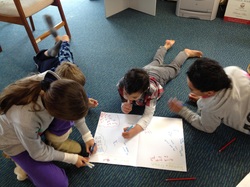
[The virtue trustworthiness can be brainstormed first]
One of the greatest qualities in the sight of God is trustworthiness. A trustworthy person is truthful and honest and can be counted on to keep his or her word. We should not say one thing but do another. Our actions should always reflect our words. When we are trustworthy, others can be sure that we will do our best to fulfill our responsibilities and carry out our duties. In this way, people are able to work together in harmony, knowing that everyone will do his or her part. To help us remember the importance of trustworthiness, let us memorize the following quotation:
“Trustworthiness is the greatest portal leading unto the tranquillity and security of the people.” listen HERE.
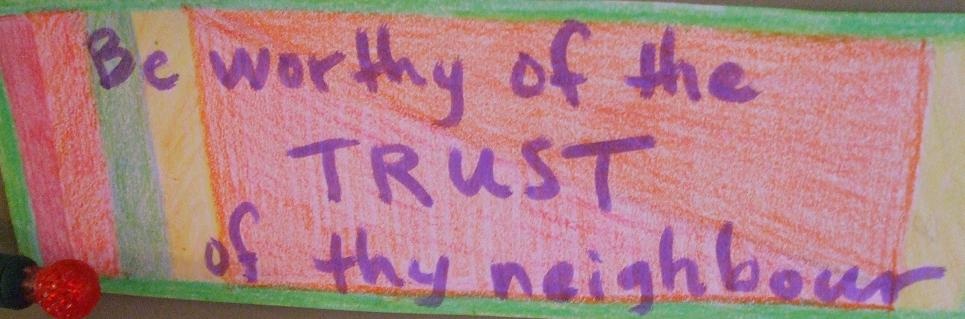
[Alternative quotes: Be worthy of the trust of thy neighbour, and look upon him with a bright and friendly face. (Baha'u'llah)]
One of the greatest qualities in the sight of God is trustworthiness. A trustworthy person is truthful and honest and can be counted on to keep his or her word. We should not say one thing but do another. Our actions should always reflect our words. When we are trustworthy, others can be sure that we will do our best to fulfill our responsibilities and carry out our duties. In this way, people are able to work together in harmony, knowing that everyone will do his or her part. To help us remember the importance of trustworthiness, let us memorize the following quotation:
“Trustworthiness is the greatest portal leading unto the tranquillity and security of the people.” listen HERE.
[Alternative quotes: Be worthy of the trust of thy neighbour, and look upon him with a bright and friendly face. (Baha'u'llah)]
Trustworthiness
1. Athos promised his mother that he would help her to prepare dinner. When his friends came to his house to invite him to play outside, Athos remembered the promise he had made to his mother and told his friends he would play with them another time. Athos showed the quality of trustworthiness.
2. The coach told Sunita that he had accepted her on the volleyball team, but he asked her not to mention it to anyone until he made the official announcement. Though Sunita was very excited, she did not tell even her closest friends. Sunita acted with trustworthiness.
Tranquility
1. Whenever Emilio has to make an important decision, he tries to find a quiet place to think and meditate. He goes to a nearby garden, and in its tranquility, he is able to clear his mind and heart.
2. Once the great storm had passed, everything became unusually quiet and still. Peace and tranquility followed the storm.
Security
1. When a baby animal is frightened, it will often run back to its mother for safety. The mother provides security to her offspring.
2. When Tabitha got lost in the mountains, the guides from the village below came to look for her. She felt a sense of security when they found her, knowing that they would lead her back to safety.
1. Athos promised his mother that he would help her to prepare dinner. When his friends came to his house to invite him to play outside, Athos remembered the promise he had made to his mother and told his friends he would play with them another time. Athos showed the quality of trustworthiness.
2. The coach told Sunita that he had accepted her on the volleyball team, but he asked her not to mention it to anyone until he made the official announcement. Though Sunita was very excited, she did not tell even her closest friends. Sunita acted with trustworthiness.
Tranquility
1. Whenever Emilio has to make an important decision, he tries to find a quiet place to think and meditate. He goes to a nearby garden, and in its tranquility, he is able to clear his mind and heart.
2. Once the great storm had passed, everything became unusually quiet and still. Peace and tranquility followed the storm.
Security
1. When a baby animal is frightened, it will often run back to its mother for safety. The mother provides security to her offspring.
2. When Tabitha got lost in the mountains, the guides from the village below came to look for her. She felt a sense of security when they found her, knowing that they would lead her back to safety.
Tower of trust:
- If your mom asks you to pick up your toys, can she count on you to do it?
- Can she count on you to pick up those toys, even if she isn’t looking?
- come up with examples of how we can build the trust in each other -> examples taped to blocks.
- what happens if we lie about one of those things: It has taken a long time to build your mum’s trust in you. But it doesn’t take long at all to destroy the tower of trust. What if you tell your mum you picked up all your toys, and she finds them under the rug? Will that help her trust you? Then let’s pull a block from the base of our tower of trust. Every untrue thing you say takes away a little of the trust people have in you.
**Another idea for discussion is to give the children a list of virtues, and to think about a friend (don't say who it is, because that would be backbiting), then circle which virtues they do have. For trustworthiness, think about how you would encourage a friend who's not trustworthy to develop that quality, because, we have to train hard every day to develop our virtue muscles...E.g. letting another friend hold money while walking together to the shop...**
- If your mom asks you to pick up your toys, can she count on you to do it?
- Can she count on you to pick up those toys, even if she isn’t looking?
- come up with examples of how we can build the trust in each other -> examples taped to blocks.
- what happens if we lie about one of those things: It has taken a long time to build your mum’s trust in you. But it doesn’t take long at all to destroy the tower of trust. What if you tell your mum you picked up all your toys, and she finds them under the rug? Will that help her trust you? Then let’s pull a block from the base of our tower of trust. Every untrue thing you say takes away a little of the trust people have in you.
**Another idea for discussion is to give the children a list of virtues, and to think about a friend (don't say who it is, because that would be backbiting), then circle which virtues they do have. For trustworthiness, think about how you would encourage a friend who's not trustworthy to develop that quality, because, we have to train hard every day to develop our virtue muscles...E.g. letting another friend hold money while walking together to the shop...**
D. Story
Years ago, in the early days of the Faith, there were only a small number of Bahá’ís, spread out over several countries. They faced many challenges, and often wrote to Bahá’u’lláh, and later to ‘Abdu’l-Bahá, in the Holy Land, conveying news of the progress of the Faith and posing various questions. Their letters travelled over long distances before reaching their destination, and Bahá’u’lláh and ‘Abdu’l-Bahá would answer each one with great love and care. The beautiful verses that flowed from Their pens were as precious gifts to the believers that received them. Their words of encouragement strengthened those early Bahá’ís and cheered their hearts. And so it was crucial that this stream of communication not be disrupted.
During one of the darkest periods in the history of the Faith, its enemies rose up against ‘Abdu’l-Bahá. Jealous of His growing influence, they hoped to bring about His exile, or worse still, His execution. Spies were planted all around His house, and He was kept under constant watch. How pleased His enemies would have been if they could have stopped the flow of correspondence and broken the link between ‘Abdu’l-Bahá and the devoted friends; how much more if they could have stolen some document that could be used to mislead the authorities! ‘Abdu’l-Bahá, however, was not deterred. He could often be seen late into the night, writing by the light of His lamp; for He had ensured a secure means for the receipt and dispatch of mail, a task that could only be given to the most trusted of believers.
There lived in the area a man named Siyyid Muḥummad-Taqi Manshadt. He had come from Persia when he was fairly young and had established a small business in Haifa. There, he welcomed to his home the many friends who visited the Holy Land. He helped them in making travel arrangements and became known for his unwavering reliability. So dependable was he that his home had become a center through which passed nearly all of the mail for the Bahá’ís in the Holy Land and the responses sent abroad. Everyone knew that he could be trusted to make sure each piece of mail was delivered promptly and securely.
Of course the enemies of the Faith knew this as well, and so Siyyid Muḥummad-Taqi Manshádí was in great danger. ‘Abdu’l-Bahá could see that they would use every means possible to harm the Cause. They would no doubt try to intercept the mail, and Muḥummad-Taqi would soon become the target of their schemings. So what do you think ‘Abdu’l-Bahá did? Such confidence did He have in Muḥummad-Taqi that He did not want to let go of his valuable services. So He sent him to safety in nearby Port Said in Egypt and arranged for others, that His enemies would not suspect, to carry mail back and forth to him. And there, in Port Said, Muḥummad-Taqi continued to dispatch and receive mail for Bahá’ís in distant lands as he had always done, never faltering in the trust ‘Abdu’l-Bahá had placed in him. So it was that even in the darkest of times, the light of guidance that shone forth from the Holy Land continued to reach the friends in the most remote places.
[Alternative story from HERE:
We told a great story about a little boy who was in a class that was working on calligraphy, and 'Abdu'l-Baha was taking the time to look at all of the children's work every week. 'Abdu'l-Baha would comment on the work always in an encouraging way, praising the children, and offering any help if the children needed any. The little boy in the story created some beautiful calligraphy one week, and when he showed it to 'Abdu'l-Baha, 'Abdu'l-Baha saw how beautiful it was and he praised the little boy's work and wrote a comment on it (something like, "Excellent work!"). The boy was so proud and happy that 'Abdu'l-Baha had praised his work. The next week, however, the boy realized at the end of the week that he didn't have a good quality calligraphy done to show 'Abdu'l-Baha. So instead of showing him his real work for the week, the boy took the calligraphy that 'Abdu'l-Baha had already praised the week before, tore off the comment that 'Abdu'l-Baha had written, and showed exactly the same work to 'Abdu'l-Baha. When 'Abdu'l-Baha saw the work, he said kindly, "That work looks familiar," and handed the work back to the boy without any praise, without any written comment. The boy realized that he had lost 'Abdu'l-Baha's trust by trying to trick him, and after that he never tried doing something like that again.]
Years ago, in the early days of the Faith, there were only a small number of Bahá’ís, spread out over several countries. They faced many challenges, and often wrote to Bahá’u’lláh, and later to ‘Abdu’l-Bahá, in the Holy Land, conveying news of the progress of the Faith and posing various questions. Their letters travelled over long distances before reaching their destination, and Bahá’u’lláh and ‘Abdu’l-Bahá would answer each one with great love and care. The beautiful verses that flowed from Their pens were as precious gifts to the believers that received them. Their words of encouragement strengthened those early Bahá’ís and cheered their hearts. And so it was crucial that this stream of communication not be disrupted.
During one of the darkest periods in the history of the Faith, its enemies rose up against ‘Abdu’l-Bahá. Jealous of His growing influence, they hoped to bring about His exile, or worse still, His execution. Spies were planted all around His house, and He was kept under constant watch. How pleased His enemies would have been if they could have stopped the flow of correspondence and broken the link between ‘Abdu’l-Bahá and the devoted friends; how much more if they could have stolen some document that could be used to mislead the authorities! ‘Abdu’l-Bahá, however, was not deterred. He could often be seen late into the night, writing by the light of His lamp; for He had ensured a secure means for the receipt and dispatch of mail, a task that could only be given to the most trusted of believers.
There lived in the area a man named Siyyid Muḥummad-Taqi Manshadt. He had come from Persia when he was fairly young and had established a small business in Haifa. There, he welcomed to his home the many friends who visited the Holy Land. He helped them in making travel arrangements and became known for his unwavering reliability. So dependable was he that his home had become a center through which passed nearly all of the mail for the Bahá’ís in the Holy Land and the responses sent abroad. Everyone knew that he could be trusted to make sure each piece of mail was delivered promptly and securely.
Of course the enemies of the Faith knew this as well, and so Siyyid Muḥummad-Taqi Manshádí was in great danger. ‘Abdu’l-Bahá could see that they would use every means possible to harm the Cause. They would no doubt try to intercept the mail, and Muḥummad-Taqi would soon become the target of their schemings. So what do you think ‘Abdu’l-Bahá did? Such confidence did He have in Muḥummad-Taqi that He did not want to let go of his valuable services. So He sent him to safety in nearby Port Said in Egypt and arranged for others, that His enemies would not suspect, to carry mail back and forth to him. And there, in Port Said, Muḥummad-Taqi continued to dispatch and receive mail for Bahá’ís in distant lands as he had always done, never faltering in the trust ‘Abdu’l-Bahá had placed in him. So it was that even in the darkest of times, the light of guidance that shone forth from the Holy Land continued to reach the friends in the most remote places.
[Alternative story from HERE:
We told a great story about a little boy who was in a class that was working on calligraphy, and 'Abdu'l-Baha was taking the time to look at all of the children's work every week. 'Abdu'l-Baha would comment on the work always in an encouraging way, praising the children, and offering any help if the children needed any. The little boy in the story created some beautiful calligraphy one week, and when he showed it to 'Abdu'l-Baha, 'Abdu'l-Baha saw how beautiful it was and he praised the little boy's work and wrote a comment on it (something like, "Excellent work!"). The boy was so proud and happy that 'Abdu'l-Baha had praised his work. The next week, however, the boy realized at the end of the week that he didn't have a good quality calligraphy done to show 'Abdu'l-Baha. So instead of showing him his real work for the week, the boy took the calligraphy that 'Abdu'l-Baha had already praised the week before, tore off the comment that 'Abdu'l-Baha had written, and showed exactly the same work to 'Abdu'l-Baha. When 'Abdu'l-Baha saw the work, he said kindly, "That work looks familiar," and handed the work back to the boy without any praise, without any written comment. The boy realized that he had lost 'Abdu'l-Baha's trust by trying to trick him, and after that he never tried doing something like that again.]
E. Game: “The Blind Man”
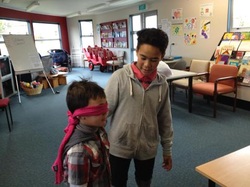
Divide the students into pairs. Blindfold one child in each pair and have the other child lead him or her around, making sure that he or she does not stumble along the way. For an added challenge, the blindfolded child can be guided around obstacles, such as tree trunks, ditches, rocks, and tires. To increase your student’s capacity for giving and receiving instructions, the blindfolded child can be guided through verbal instructions alone. In the case, the guide should follow close by to catch the child in case he or she stumbles.
As an alternative to the above game, the students can all be blindfold and form a train, led by you or one of the children.
At the end, discuss whether you felt like you could trust your partner or not.
Divide the students into pairs. Blindfold one child in each pair and have the other child lead him or her around, making sure that he or she does not stumble along the way. For an added challenge, the blindfolded child can be guided around obstacles, such as tree trunks, ditches, rocks, and tires. To increase your student’s capacity for giving and receiving instructions, the blindfolded child can be guided through verbal instructions alone. In the case, the guide should follow close by to catch the child in case he or she stumbles.
As an alternative to the above game, the students can all be blindfold and form a train, led by you or one of the children.
At the end, discuss whether you felt like you could trust your partner or not.
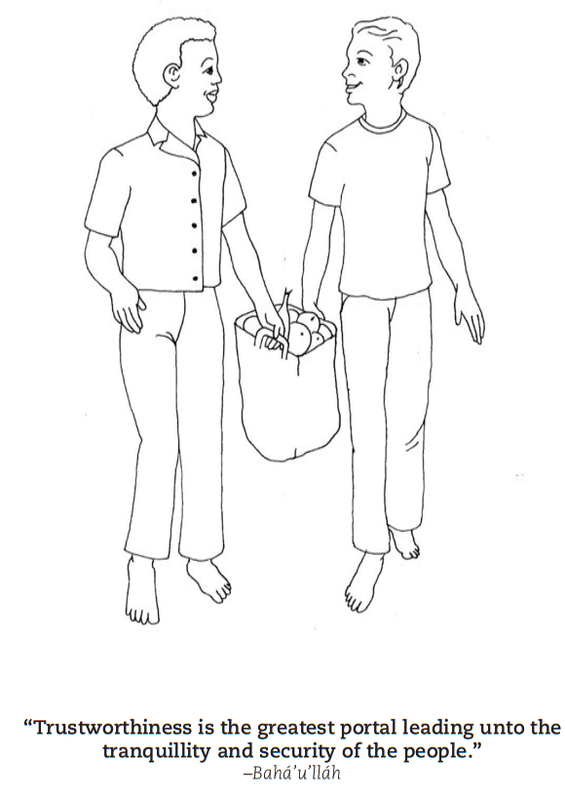
F. Colouring: Drawing 19
From SoulFriendClass:
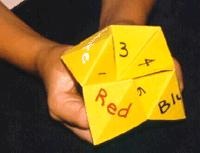
Art activity: making "fortune tellers" - those paper triangle-folded games that you ask questions and then the paper reveals an answer. A sort of "searching for truth" game, however we knew it wasn't a trustworthy source to ask!
Art activity: making "fortune tellers" - those paper triangle-folded games that you ask questions and then the paper reveals an answer. A sort of "searching for truth" game, however we knew it wasn't a trustworthy source to ask!
Extra activities:
1. Create a "trustworthy friend kit": Make a friendship kit to remind children of what it takes to be a trustworthy friend. Ask the students to label an envelope or ziplock baggie “Friendship Kit” and decorate it. Have them place the things on this list below inside the envelope. Cut out the list and put it in the friendship kit, too. Ask the children to take their friendship kit home and tell their family what each thing in the kit stands
for.
Tape- - Stick up for your friend.
Bandage- Never let a friend do anything to harm himself or herself.
Button- “Button your lips” and keep a secret for a friend.
Candy Heart- Have the courage to do the right thing.
Word Card: Truth- Remember to always speak the truth. Be honest and sincere with your friend.
Eraser- Everyone makes mistakes. Forgive a friend’s mistakes.
Mint- A trustworthy friend is worth a mint.
2. Have students create original bumper sticker designs promoting the value and importance of honesty in the lives of students]
3. Could do a calligraphy exercise for the quote - to relate back to the story re: calligraphy.
1. Create a "trustworthy friend kit": Make a friendship kit to remind children of what it takes to be a trustworthy friend. Ask the students to label an envelope or ziplock baggie “Friendship Kit” and decorate it. Have them place the things on this list below inside the envelope. Cut out the list and put it in the friendship kit, too. Ask the children to take their friendship kit home and tell their family what each thing in the kit stands
for.
Tape- - Stick up for your friend.
Bandage- Never let a friend do anything to harm himself or herself.
Button- “Button your lips” and keep a secret for a friend.
Candy Heart- Have the courage to do the right thing.
Word Card: Truth- Remember to always speak the truth. Be honest and sincere with your friend.
Eraser- Everyone makes mistakes. Forgive a friend’s mistakes.
Mint- A trustworthy friend is worth a mint.
2. Have students create original bumper sticker designs promoting the value and importance of honesty in the lives of students]
3. Could do a calligraphy exercise for the quote - to relate back to the story re: calligraphy.
G. Closing Prayers

|
| ||||
Trustworthiness from The Family Virtues Guide
"When you make a vow to God, do no delay to fulfil it. For he has no pleasure in fools; what you vow, fulfil. It is better not to vow at all than to vow and not fulfil." - Ecclesiastes 5:34
What Is Trustworthiness?
Trustworthiness means you can be counted on. When you are trustworthy, if you make a promise or a vow, you keep your word no matter how hard it becomes.
When you are practising trustworthiness, others can rely on you. They can trust that if it is at all possible, you will do what you said you would.
Being trustworthy means that if someone asks you to do something, and you start out to do it, you will finish it (and do your best) even if it becomes really hard.
People who practice trustworthiness are known for their determination, their reliability, and their truthfulness. They keep their word. Others know they can be trusted.
Why Practice Trustworthiness?
Without trustworthiness, agreements and promises don't mean anything. When people don't practice trustworthiness, sometimes they keep a promise, and sometimes they don't. You never know what you can expect of someone who is untrustworthy. When someone cannot be trusted, people become sad and disappointed. If you are not trustworthy, other people never know if they can believe you or count on you.
If you are trustworthy, others can trust you because you keep your word. They don't have to doubt you or check up on you to see if you are doing something you promised to do.
When people are trustworthy with each other, they can relax, knowing that promises will be kept. When people are trustworthy, they can be trusted to tell the truth, to do their part, to give their best. A trustworthy person is the best friend anyone could ever have.
How Do You Practice It?
When you are practising trustworthiness, you stop and think before making a promise, to be sure it is something you really want to do and that you really can do it.
You practice trustworthiness by making a promise to someone or to yourself. Decide to keep your promise rather than just trying to. Start doing what you agreed to do and watch out for things which could prevent you from keeping your agreement. There are traps of obstacles that come along, such as distractions, or feeling to tired, or a job being much harder than you thought it would be.
When you are trustworthy, you keep your word. You keep going, no matter how hard it becomes, because it is very important to you to be worthy of the trust of others.
What would trustworthiness look like if...
Signs of Success
What Is Trustworthiness?
Trustworthiness means you can be counted on. When you are trustworthy, if you make a promise or a vow, you keep your word no matter how hard it becomes.
When you are practising trustworthiness, others can rely on you. They can trust that if it is at all possible, you will do what you said you would.
Being trustworthy means that if someone asks you to do something, and you start out to do it, you will finish it (and do your best) even if it becomes really hard.
People who practice trustworthiness are known for their determination, their reliability, and their truthfulness. They keep their word. Others know they can be trusted.
Why Practice Trustworthiness?
Without trustworthiness, agreements and promises don't mean anything. When people don't practice trustworthiness, sometimes they keep a promise, and sometimes they don't. You never know what you can expect of someone who is untrustworthy. When someone cannot be trusted, people become sad and disappointed. If you are not trustworthy, other people never know if they can believe you or count on you.
If you are trustworthy, others can trust you because you keep your word. They don't have to doubt you or check up on you to see if you are doing something you promised to do.
When people are trustworthy with each other, they can relax, knowing that promises will be kept. When people are trustworthy, they can be trusted to tell the truth, to do their part, to give their best. A trustworthy person is the best friend anyone could ever have.
How Do You Practice It?
When you are practising trustworthiness, you stop and think before making a promise, to be sure it is something you really want to do and that you really can do it.
You practice trustworthiness by making a promise to someone or to yourself. Decide to keep your promise rather than just trying to. Start doing what you agreed to do and watch out for things which could prevent you from keeping your agreement. There are traps of obstacles that come along, such as distractions, or feeling to tired, or a job being much harder than you thought it would be.
When you are trustworthy, you keep your word. You keep going, no matter how hard it becomes, because it is very important to you to be worthy of the trust of others.
What would trustworthiness look like if...
- Your mother sent you to the store and asked you to bring back the change
- Your friend told you a secret that he doesn't want anyone else to know?
- You promised to do a chore but start to get distracted by TV or a book?
- Someone asks you to do something that you know in your heart is too hard for you to do?
- You have a daily job to do for your family and you don't feel like doing it?
Signs of Success
| Congratulations! You are being trustworthy when you..
| Keep trying! You need more practice when you...
|
AFFIRMATION
I am trustworthy. I keep my promises. I keep my word. I am worthy of the trust that others place in me.
I am trustworthy. I keep my promises. I keep my word. I am worthy of the trust that others place in me.
 RSS Feed
